Split systems
Split system air conditioning in London
A split system has two parts joined by insulated copper pipes: an indoor unit high on the wall and an outdoor unit outside. It is the most common type of home air conditioning in London because it is quiet indoors, efficient, heats as well as cools, and needs only one small hole through the wall.
Start a quote
Air conditioning quote
Tell us about the rooms. The installer will confirm sizes and positions on a free survey.
- 01The space
- 02Your building
- 03What you want
- 04Your details
The space
Which rooms need cooling?
Pick all that apply.
The space
How many indoor units do you think?
Your building
What type of property?
Your building
Where could the outdoor unit go?
Your building
What are the outside walls?
What you want
Do you want it to heat as well?
Most split systems can run in reverse as an air to air heat pump.
What you want
When would you like it fitted?
What you want
What is the postcode?
So the right engineer for your area picks it up.
Your details
Your quote is confirmed at a free survey
Unit sizes depend on room size, windows, insulation and where the outdoor unit can go. The installer checks all of that in person before giving a fixed price.
You need this when
- You want to cool one or two specific rooms
- You have a rear wall, flat roof or lightwell for an outdoor unit
- You want something quieter and stronger than a portable unit
- You want heating in a room the radiators do not reach well
How a split system works
Air conditioning moves heat rather than making cold. Inside, a fan blows room air across a cold coil. The refrigerant in the coil picks up the heat and carries it through the pipes to the outdoor unit, where a compressor and a second coil release it outside. In winter many systems run the same cycle in reverse and bring heat in, which is why reversible split systems are also called air to air heat pumps.
Because the noisy compressor sits outside, the indoor unit is much quieter than a portable or all in one unit. Most modern units use an inverter, which means the compressor speeds up and slows down instead of switching on and off, so the temperature stays steady.
Positions that work in London homes
The indoor unit usually sits high on an outside wall so the pipes can go straight through. If the room you want to cool is at the front of a house in a conservation area, the pipes can run inside a ceiling void or a neat cover to a rear wall instead.
For the outdoor unit, we look for:
- a rear wall at ground floor level
- a flat roof at least 1 metre from the edge
- a lightwell or side return with good airflow
- a position away from neighbours' bedroom windows
Pipe runs of several metres are normal, so the two units do not need to be back to back.
Refrigerant, efficiency and the F-gas rules
Most new home split systems use R32, a refrigerant with a lower climate impact than the older R410A. Refrigerants are fluorinated gases, so the law controls who can handle them. The engineer must hold a personal F-gas qualification and work for a company certified by an approved body such as Refcom or the F-Gas Register. Ask for the company certificate number before you book and check it on the register.
For efficiency, look at the SEER (cooling) and SCOP (heating) ratings on the product label. Higher numbers mean more heat moved per unit of electricity. A correctly sized, well positioned unit will get closer to those figures than an oversized one that cycles on and off.
Split system or something else?
A single split is best for one room. If you want three or four rooms cooled, a multi split can run several indoor units from one outdoor unit, saving wall space outside. If you do not want any unit visible in the room, a ducted system hides in the ceiling. If there is nowhere for an outdoor unit at all, an all in one unit is the fallback. We explain the trade offs after seeing the property, and you can read more on our multi split and ducted pages.
What happens on the day
A single split is usually the simplest install. Dust sheets go down, the indoor unit bracket is fixed and levelled, and one hole is cored through the wall with the dust extracted. The outdoor unit goes on wall brackets or a ground frame with anti vibration mounts. The copper pipes are flared or brazed, then pressure tested with nitrogen and evacuated before the refrigerant is released. The electrician connects the new circuit and isolator, and the system is run in cooling and heating. Before leaving, the engineer should show you the remote, the filters and how to keep the outdoor unit clear.
What affects the price
A single split is the simplest system to install, but the price still depends on the unit size, the pipe length, how high the outdoor unit goes, access, and the electrical connection. Prices are confirmed after a survey.
| What | Price |
|---|---|
| Single room split system | about £1,900 for a single room air to air system (Energy Saving Trust typical figure) |
| Extra pipe length and covers | quote on survey |
| Outdoor unit on a flat roof or high wall | quote on survey |
| Dedicated electrical circuit | quote on survey |
No prices are shown on this site. Every job is priced after a look at it, by photo or a visit.
How the job runs
-
We agree where the indoor unit goes for even airflow and where the outdoor unit can legally and quietly sit.
-
One hole, usually around 65mm, is drilled through the wall for the pipes, cable and condensate drain.
-
The indoor unit is hung, the outdoor unit is fixed on brackets or a frame, and the pipes are joined and insulated.
-
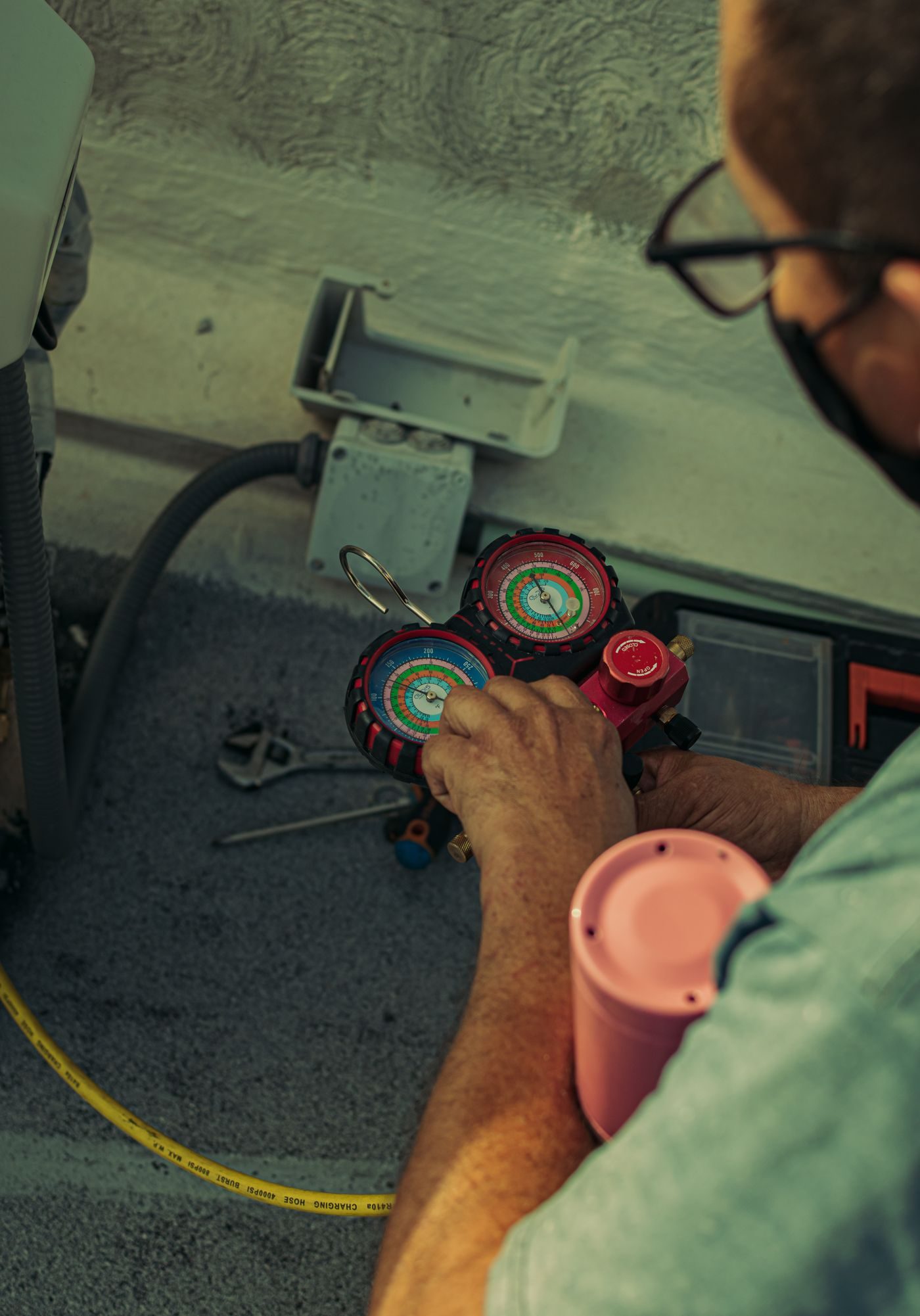
The pipes are pressure tested and evacuated, the refrigerant is released or topped up to the correct charge, and the system is run and checked.
Every price is agreed in writing before work starts.
Start a quoteWhat is the difference between split and portable air conditioning?
A split system keeps the compressor outside, so it is quieter and more efficient, and it needs no window hose. A portable unit has everything inside and vents hot air through a hose, which loses a lot of its cooling.
Can a split system heat as well as cool?
Most modern split systems are reversible and heat very efficiently in mild and cold weather. Used this way they are air to air heat pumps.
How far can the outdoor unit be from the indoor unit?
Several metres is normal and many units allow much more. Each model has a maximum pipe length and height difference set by the manufacturer.
Can I fit a split system myself?
No. Connecting and charging the refrigerant circuit must be done by an F-gas qualified engineer, and the new circuit must meet Part P. DIY installs also usually void the warranty.
Split systems
Send it through and get a reply
Describe the rooms or the problem in a sentence. Photos of the wall and the outside space help if you can text them later.