Short answer: Usually yes. Most London flats can have air conditioning once three things are sorted: written consent from the freeholder or landlord, a legal and quiet spot for the outdoor unit, and planning permission if the job falls outside permitted development, which it often does for flats. Where no outdoor spot exists, an all in one unit can work.
London is a city of flats
More than half of London households live in a flat. The 2021 Census puts it at 54%, compared with about 22% across England and Wales. So when people in London ask about air conditioning, they are mostly asking about flats.
Flats are also where the heat builds up. The Greater London Authority’s heat risk study found higher risk for homes towards the centre of London, naming Tower Hamlets, Hackney, Islington and Camden, partly because these boroughs have more flats. A flat gets heat from the roof, from the flats around it and from its windows, and it rarely has the cross breeze a house can get by opening front and back.
The three questions, in the right order
1. What does your lease or tenancy say?
If you own a leasehold flat, you usually own the inside but not the outside walls, the roof or the structure. Fixing an outdoor unit or drilling a pipe hole touches all of these. The alterations clause in your lease will normally say you need the freeholder’s written consent, and many freeholders grant it through a formal licence for alterations.
If you rent, you need your landlord’s permission, and the landlord may need the freeholder’s consent as well. Our guide to air conditioning in a rented flat covers that route.
2. Is there a legal spot for the outdoor unit?
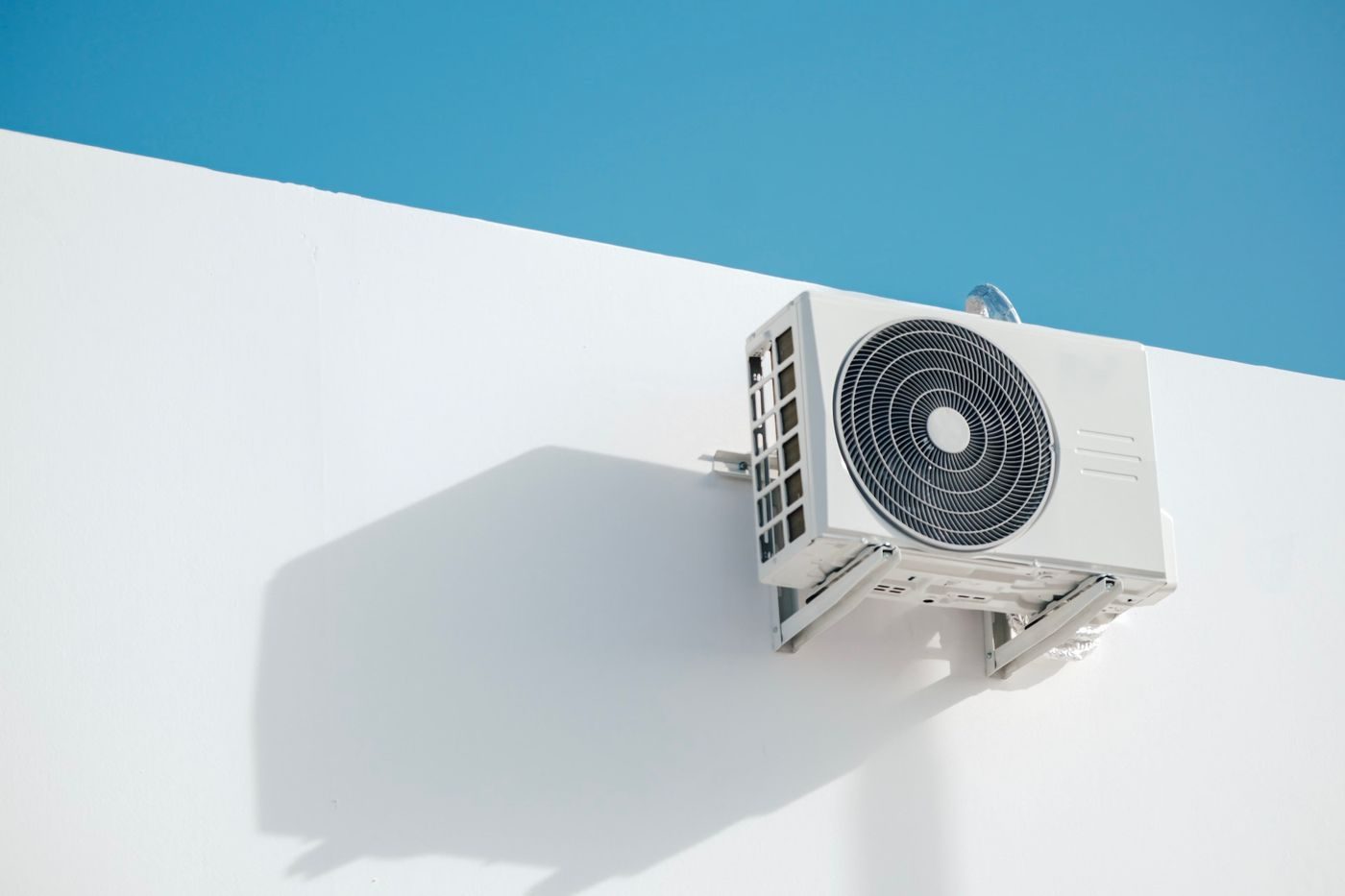
The outdoor unit needs air around it, a fixing the building owner accepts, and a position that keeps noise at the nearest neighbour’s window low. Common spots for flats are a rear wall, a shared flat roof, a lightwell or a balcony where the lease allows it. Front walls in conservation areas are out, and pitched roofs are not permitted development.
3. Does it need planning permission?
This is where flats differ most from houses. Permitted development for heat pumps under Class G applies to a house or a block of flats as a whole, not to one flat. The Planning Portal sets out the limits:
| Rule | House | Block of flats |
|---|---|---|
| Number of outdoor units | one (two if detached) | one for the whole block |
| Maximum outdoor unit size | 1.5 cubic metres | 0.6 cubic metres |
| Building type | any house | must be wholly flats, so not above shops |
| Use | not solely for cooling | not solely for cooling |
| Listed building | not permitted | not permitted |
If another flat in your block already has a heat pump, there is no permitted development allowance left. If your block has a shop, café or office on the ground floor, it is not a block of flats under these rules at all. And a cooling only air conditioner is never covered. So most flat installs in London end up as a planning application.
New build flats: Canary Wharf and beyond
New build towers around Canary Wharf, the Isle of Dogs and Wapping raise their own questions. Blocks approved since June 2022 were designed under Approved Document O, which treats much of London, including E14 and E1, as a high risk location for overheating. Even so, many residents still find south and west facing flats uncomfortable in a heatwave.
In a tower, external walls are usually glass or cladding the building owner will not let you drill. Options tend to be:
- a unit on your own balcony, if the lease and the building manager allow it
- a connection to an existing building cooling system, if one was designed in
- an internal solution agreed with the building manager
Always speak to the building management team first. Many have a policy on air conditioning already. The Canary Wharf area page has more on the local stock.
Converted houses and mansion blocks
A Victorian house split into flats usually has a rear wall or a back extension roof that can take a unit, and a smaller number of leaseholders to agree with. Mansion blocks have managing agents, strict leases and often a lightwell. In both, the freeholder will want to know the unit position, the noise figure and how the condensate drains.
When there is nowhere for an outdoor unit
If the lease or the building rules out an outdoor unit, an all in one unit can work. It sits inside on an outside wall and breathes through two holes about 15 to 20cm wide, according to the Energy Saving Trust. It is louder in the room and less powerful than a split system, and it still needs the freeholder’s consent for the holes. We cover this option in air conditioning without an outdoor unit.
Rules that apply to every flat install
- Only an engineer with an F-gas qualification, working for a company certified by an approved body, can install the refrigerant circuit (gov.uk).
- The new electrical circuit is notifiable under Part P.
- Condensate water from the indoor unit must drain properly inside the flat, by gravity or with a small pump, so it does not stain walls or leak below.
A sensible order of work
- Read your lease alterations clause or ask your landlord.
- Get a survey to find a workable unit position and a noise figure.
- Send the freeholder or managing agent the unit details, position and noise figure.
- Submit a planning application if needed.
- Book the install only when consent is in writing.
Starting in winter means you are ready before the first hot week. Our flat air conditioning page shows how we prepare the consent pack.
Quick questions
Do I need permission to install air conditioning in my flat?
Yes. A leaseholder needs the freeholder's written consent, a tenant needs the landlord's permission, and the job often needs planning permission because permitted development rules are tight for blocks of flats.
Can I put an air conditioning unit on my balcony?
Sometimes. Many leases forbid fixings or equipment on balconies, and the unit still needs planning and enough airflow. Check the lease and ask the managing agent before buying anything.
Is a portable air conditioner allowed in a flat?
A portable unit is not fixed to the building, so it rarely needs consent, but it is noisy and much less effective than a split system, especially with sash windows.
How long does it take to get air conditioning in a flat?
The install itself is often quick. Consent takes longer: freeholder licences and planning decisions can take weeks, so start the paperwork early in the year.
Last updated 23 October 2026. Written for homes in London. Rules can change, so check the linked sources for the latest position.